


How to bring the CMO back to the decision-making table?
Years of economic uncertainty, inflation, and margin pressure have brought an unprecedented level of budget scrutiny. Every single euro invested is under the microscope of finance departments. We live in an era of marketing where an uncompromising rule applies: (prove it or lose it).
This is also why the traditional role of the CMO is constantly evolving and why marketing leaders are now required to make a direct, demonstrable contribution to the company's profitable growth. The renowned magazine Marketing Week in partnership with Kantar and Google has released the fifth annual global study The Language of Effectiveness 2026. A survey of more than 600 marketing managers provides a fairly clear diagnosis and, at the same time, a survival guide for modern CMOs.
The "easy measurability" trap
In a high-pressure environment, it is natural to reach for quick evidence. However, studies reveal a dangerous trend: the simplicity and availability of quick measurement have become a proxy for effectiveness itself.
- As many as 71.7% of marketers admitthat the ease of measurement has directly influenced their budget allocation over the last 12 months.
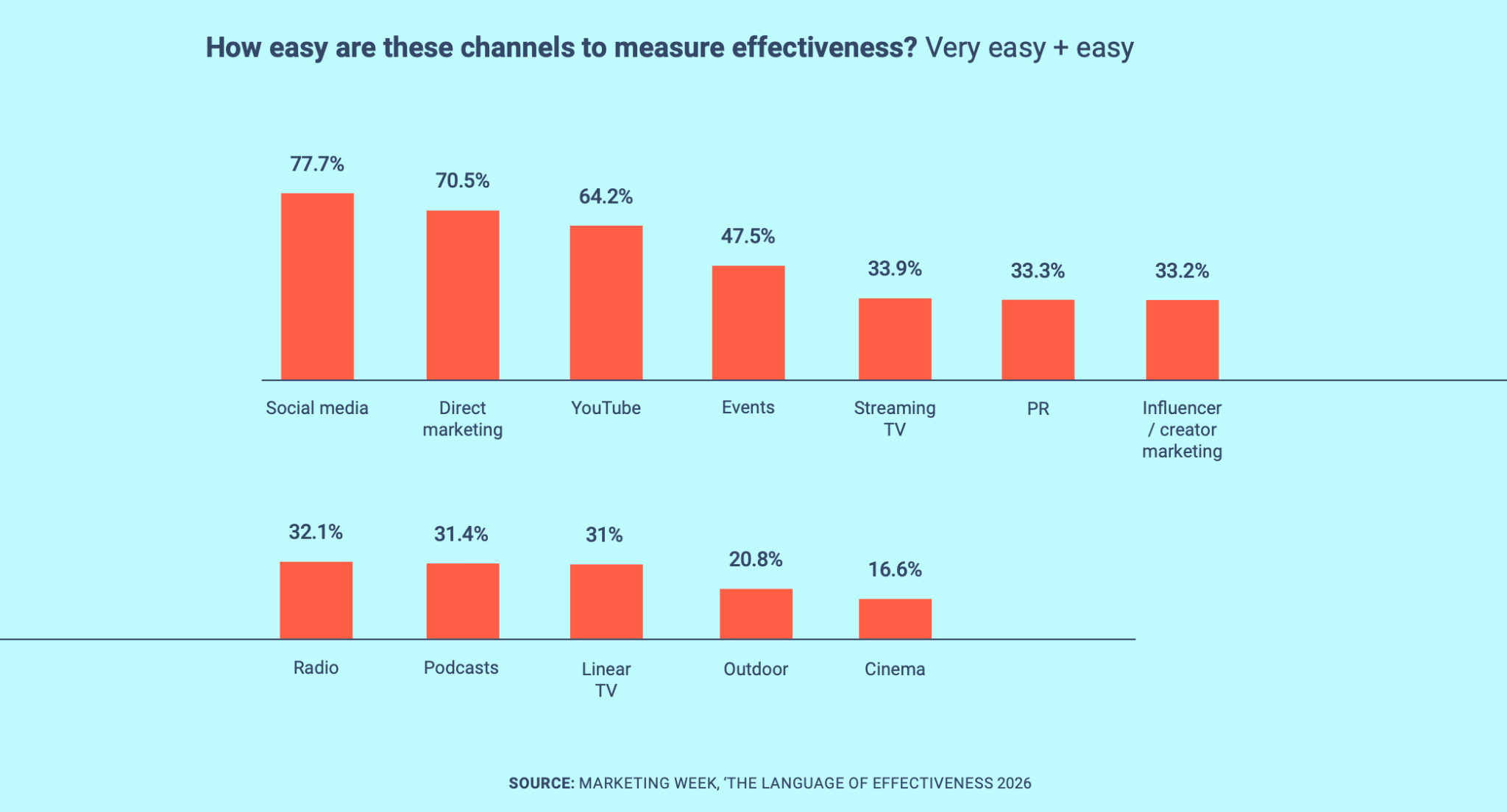
- This is precisely what led to the shift of resources into performance channels, such as social media (which 76.8% of marketers consider easy to measure) or direct marketing (70.5%).
- Conversely, brand-building or PR channels (42.8% perceive them as difficult to measure) and outdoor advertising (49.4%) remain on the sidelines.
Over the past year, 28% of marketers have strengthened performance marketing, while only 23% have invested more in brand building. "Just because something is easy to measure doesn't mean it creates the highest value for the company. Over-indexing on the bottom of the funnel leads to under-investment in the brand, which is critical for long-term growth and pricing power," says the study Munnawar Chishty, CMO at Carlsberg Britvic.
"Revenue growth or market share growth are legitimate metrics that marketing should contribute to. Beyond hard financial indicators, however, it makes sense to track proxy metrics such as Share of Search (a brand's share of search in its segment, which is a strong, predictive indicator of revenue growth, as customer searches often precede purchases). Besides marketing, many other essential factors that marketing may not directly influence also affect revenue growth. These typically include, for example, the customer experience itself, or the size and availability of distribution. The path to understanding between the CMO and leadership therefore leads through intensive mutual communication, so that leadership understands that brand investments have a long-term return and cannot be evaluated solely on the basis of monthly revenue trends," adds Ján Stareček (strategist and Head of Data Intelligence).
You are speaking a language your CFO doesn't understand
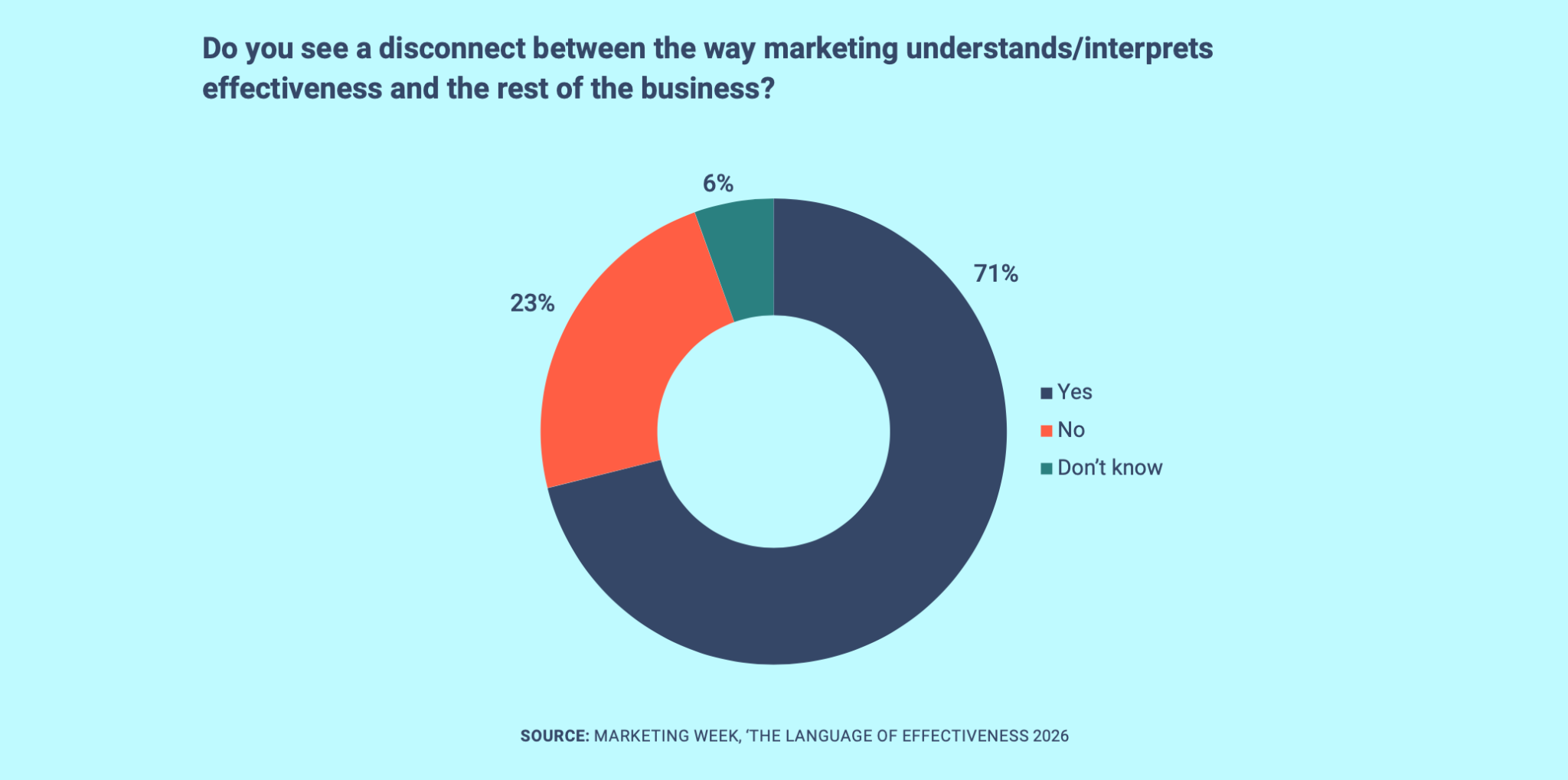
The biggest obstacle to marketing effectiveness is not found in advertising systems, but right in the boardroom. As many as 71.1% of marketers confirm a deep disconnect in how they perceive effectiveness versus how the rest of the company defines it.
While marketers report and optimize campaign-focused metrics:
- Generated leads (76.8%)
- Click-through rate / CTR (71.6%)
CEOs and CFOs look at completely different parameters:
- New customer acquisition (56.4%)
- Return on investment / ROI (50.0%)
Marketing has historically built a poor reputation among board members because it was not perceived as sufficiently data-driven or commercially oriented. As Lee Nelson, VP of Marketing at DHL eCommerce, points out: We must learn to translate every investment into a commercial decision. We need to speak the language of business, understand P&L statements, and communicate with the CFO on their level.
“Advertising works immediately, it just doesn’t show up next week because only 5% of buyers are in the market right now.”
Byron Sharp also advises against playing amateur CFO and obsessing over terms like ROI at all costs. The CMO’s job is to agree in advance on the metrics by which marketing will be measured, rather than promising sales spikes that the CFO will never attribute to marketing anyway. He recommends replacing the word “long-term” with the 95:5 framework.
“At the same time, a CMO must be equipped with market data to have arguments when discussing with leadership. To be a worthy partner in the discussion, they should know how much competing brands are investing in media—especially in TV and platforms like Meta and Google, which are the main accelerators of brand growth—and what impact these investments have on performance and, consequently, brand revenue. All this data can be obtained retrospectively and monitored on a monthly basis, making it an excellent input for discussions with management,” says Ján Stareček.
Creativity without numbers and measurement
Creativity is the most powerful tool for differentiation and multiplying communication success in a saturated market. As many as 69% of marketers agree that creative quality is a key factor in overall marketing effectiveness.
Yet, we encounter a paradox: nearly half of companies (47.9%) have no process in place to measure creative effectiveness and for 51.3% of them, such measurement is a major challenge. Although the popularity of advanced methods like AI creative testing (used by 21.1%) or eye-tracking (14%) is growing, we must not forget intuition and experience.
”Creativity can work, but it might not. It’s often a bit of a lottery, and even the best pre-tests of creative concepts don’t help; in fact, they often kill a good idea that could have multiplied communication effectiveness. For brand growth, the level of media investment and communication consistency are more important accelerators, and these are what marketers should focus on. However, it remains true that creativity itself is a multiplier of communication effectiveness,” adds Ján Stareček.
ChatGPT will sell your brand too
Artificial intelligence in marketing has come of age. It’s no longer just a toy for quickly generating text (although content generation still dominates at 67.7%). Marketers are increasingly deploying it for strategic tasks:
- Market research (51.1%)
- Audience targeting (47.4%)
- Creative testing (44.2%)
AI helps free teams from routine analysis (56.2%) and speeds up time-to-market (41.5%). But the real revolution is happening elsewhere, specifically in the customer journey.
Lee Nelson from DHL eCommerce points out a major blind spot in AI debates: “Consumers and businesses are increasingly discovering and selecting brands through large language models (LLMs). However, these models will only find and recommend you if you have a strong brand with high trust, a solid reputation, and are cited all over the web.”
The path back to the decision-making table leads through a common language
The global study The Language of Effectiveness 2026 states: the most successful organizations are those that are marketing-led and sales-driven. Where marketing collaborates with finance departments and builds campaigns as business investments, teams are rewarded with larger budgets (more than half of marketers saw budget increases after focusing on real effectiveness).
The path to the decision-making table does not lead through prettier designs or higher click-through rates. It leads through the CMO's courage to educate themselves in commercial argumentation, to combine creativity with hard data and models, and to reject traps that are easy to measure but ultimately meaningless in the long run.
This is also why we have designed a unique workshop Big Picture for CMOs, who need clear alignment with leadership and CFOs. After thorough diagnostics, market data, competitor media investments, and sales data, we emphasize collaborative work on building arguments for brand leadership, unifying the language and perspective on what drives brand success. The output is not a set of data, but clear insights that the entire team agrees on, and a prioritized action plan with which a CMO can approach leadership as a partner speaking the same language as the CFO.