


How to turn advertising into a profit multiplier
For several years now, the analytics company System1, in partnership with Effie Worldwide and the UK's IPA, has published an extensive study called The Creative Dividend. It is built on research analyzing more than 1,250 Effie campaign case studies, representing over €123 billion in market share, combined with emotional testing of more than 200,000 consumers and a database of 100,000+ ads.
The efficiency crisis and the "short-termism" trap
The massive global shift of budgets into digital channels has led brands to focus increasingly on immediate results. While marketers succumb to quarterly pressure and chase clicks, impressions, conversions, or short-term traffic, the study reveals a striking statistic: only 9% of global ads are able to report real profit growth. Focusing on short-term performance metrics fails to build brand equity and degrades media efficiency over the long run, leaving brands trapped in a cycle of promotional dependency.
Key insights for CMOs and company leadership
Just a few weeks ago, Andrew Tindall (who recently spoke in Bratislava at Marketing Rulezz) and Micky Onvural (CMO) conducted an in-depth breakdown of The Creative Dividend – From Book to Boardroom, outlining three core business pillars that should interest not just every CMO, but especially CFOs and CEOs:
- Pricing Power: A strong brand reduces customer price sensitivity. It allows a company to maintain or even increase prices without losing sales volume (Margin Expansion). Performance marketing cannot protect price—this is a unique property of "emotional" brand building.
- Residual Demand: Micky Onvural defined residual demand as the organic demand for a brand and its products that remains online and in stores even when you completely turn off all paid performance campaigns.
- Visibility in the era of AI and LLM models: Approximately two-thirds (66%) of how a brand appears and is recommended in AI search engines and large language models (LLMs) depends on its existing brand equity (brand equity). Brands that invest in their brand naturally dominate AI recommendations as well.
- B2B is highly emotional: Let's definitively reject the myth that B2B is a purely "rational world of Excel." In B2B, the sales cycle is long (6–18 months), but emotion and trust are more critical in B2B than in B2C.
4 pillars of creative effectiveness
Beating the average requires a systematic approach. Many marketers know this, but the key is convincing their leadership (CEOs and CFOs). The study introduces the Creativity Stack framework, which illustrates how individual layers of creativity multiply profit:
- Distinctiveness: Serves as a coefficient of creative effectiveness. It converts media budget directly into revenue and brand recognition. The most effective assets remain "brand characters" (fluent devices) and sound elements/jingles.
Even in Slovakia, fluent devices—specifically mascots—have appeared quite frequently in brand strategies in recent years. At Wiktor Leo Burnett, we have introduced these distinct and functional "fluent devices" into communication concepts for brands like Wilsondo or Billa, says Jakub Straka, Strategy Director at Wiktor Leo Burnett.
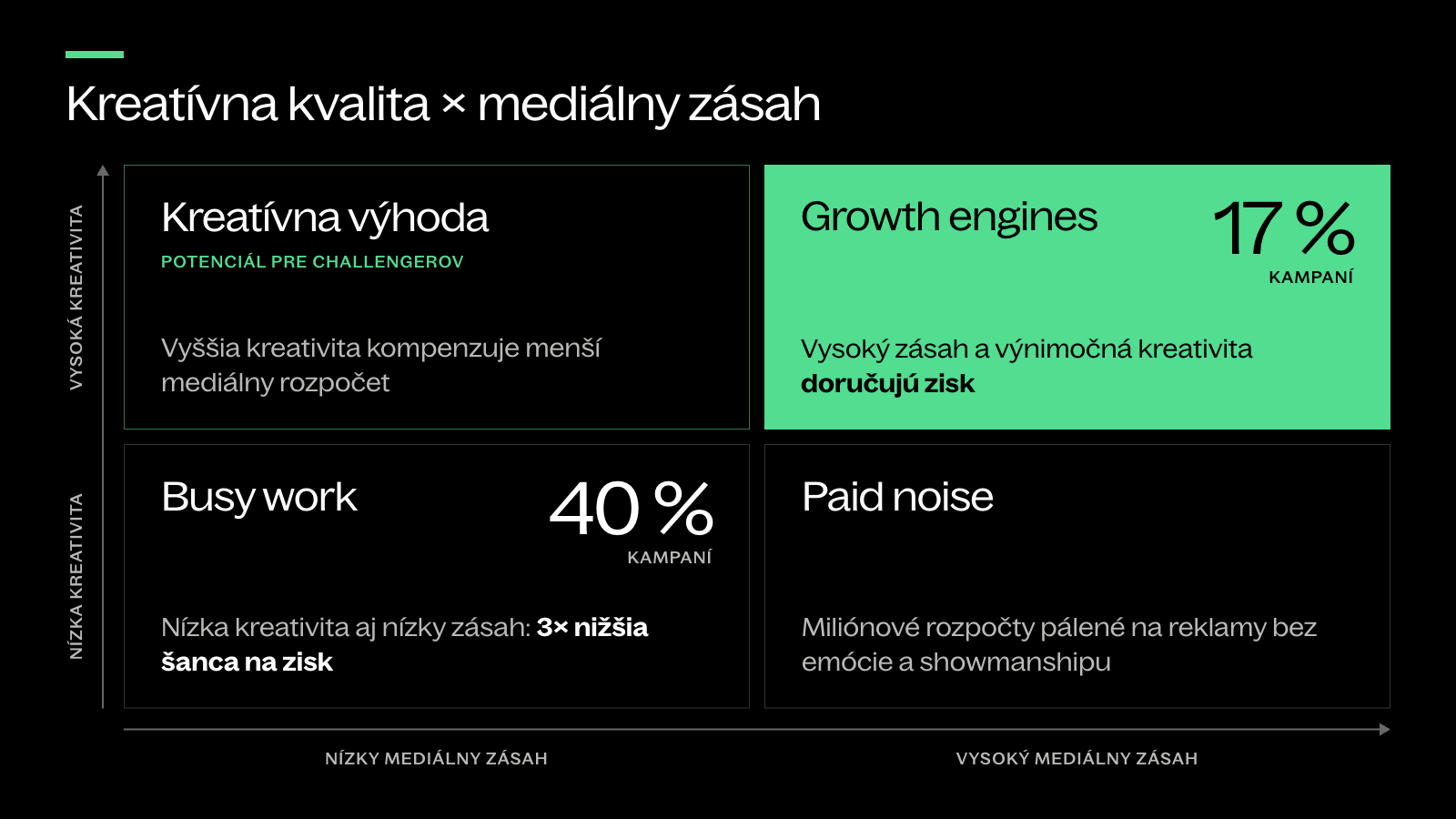
- Emotions: Without emotion, it is almost impossible to achieve incremental profit. It works through storage in long-term memory (affect heuristic). Average or boring ads (Cost of Dull) achieve 40% lower return on investment.
And what is even more interesting is that emotion is not exclusive to B2C. It should be present in any brand communication, even in B2B or any other category, adds Jakub.
- Showmanship: Advertising cannot claim attention; it must earn it through story, humor, and dramatization. Unlike Salesmanship (pushing hard for the 5% of people ready to buy today), Showmanship captures the attention of the 95% of future buyers and "light buyers."
At Wiktor Leo Burnett, we consider data to be the strongest argument, especially when a "cautious client" needs to be convinced of a bolder and emotionally expressive concept. The best tool is to trust the power of the concept and a strategy built on data. Data can support emotion, relevance, creativity, and, last but not least, the contribution to the brand.
- Consistency: Long-term maintenance of the same strategy, concept, and brand codes brings 4x higher ROI and a 3x higher probability of profit. Brands with weak emphasis on communication consistency achieve no growth in distinctiveness over time.
In terms of consistency, it is important to make the right decision as to whether the current concept has been exhausted and there is a reason to change it. This requires quite strong cooperation between the client and the agency, because such important decisions require data and research. Data can often navigate us better than any gut feeling. However, it is important to be able to interpret data in context so that we don't kill a functional concept just because the last campaign was weaker and we see a slight decline, adds Jakub.
ESOC Matrix - connecting media and creative
The traditional metric Excess Share of Voice (ESOV) looks purely at media budget while ignoring creative quality. The ESOC (Excess Share of Creativity) framework unites media reach and creative quality into a single model, showing that higher ESOC scores drive exponential profit growth.
How to start communicating more effectively with leadership?
The Creative Dividend updates published so far offer several key recommendations for CMOs and marketers:
- Realign your KPIs: Do not measure brand investments using performance marketing metrics (clicks, CTR). Instead, track reduced price sensitivity, organic demand growth, and market penetration.
- Maintain a 3-year horizon: Emotional and highly distinctive campaigns deliver the greatest profit multiplier when they run for 3 years or more (up to 7.5x). Do not change the concept after the first season just because the agency or internal team is tired of it.
- Unite media and creativity: Evaluate your portfolio assets using the ESOC matrix. Allocate media budget only to those creative formats that demonstrably achieve high emotional impact and brand recognition.
The creative quality of advertising is neither a subjective matter nor an aesthetic gamble; it is the single most powerful financial profit multiplier available to leadership. When executives succumb to fear and opt for "safe," dull, or purely performance-driven concepts, they aren't mitigating risk—they are generating costly Paid Noise that consumers instantly filter out. Data analysis makes it unmistakably clear: running average advertising is ultimately the most expensive decision a brand can make.